

Melia Havelock’s story began in Imperial Calendar 2270, when she was twenty-four years old and living a peaceful life in a halfling burrow with her husband Nicker Havelock and their two young children, Boberry and Petal. The burrow was part of a small homestead shared with other families, including the Millponds and Havelocks, who made their living milling grain and producing flour. On this particular evening, Melia sat by the hearth weaving a basket from cattail reeds while her four-year-old daughter Petal tried to mimic her and her three-year-old son Boberry playfully bothered his sister with uncleaned cattails. Nicker had gone outside at dusk to check on the chickens, which had been making a fuss in their coop.
The peaceful domestic scene was shattered when Belfast, the family dog, suddenly became alert and walked toward the door to the outside room. Melia noticed the unusual behavior and called out to the dog, but Belfast only sniffed around before beginning to growl—a growl that was abruptly cut off mid-sound. Concerned, Melia told Petal it was almost time for bed and followed Belfast into the dark front room, where she found the door to the outside standing open. In the darkness, she could make out a small figure sitting in one of the plush chairs, appearing to pet something on their lap. When Melia called for Boberry, she received no answer, and as she moved closer, she tripped over something furry on the ground—Belfast’s lifeless body.
As Melia began to yell for Boberry and Nicker, the figure in the chair instantaneously appeared directly in front of her face, cutting her scream short. The creature had red eyes and a blood-smeared face twisted into a wide grin, and it stared at Melia with unsettling curiosity. It grabbed her hand softly and placed a heavy object into her grip, something that felt like cloth with soft skin inside, maintaining intense eye contact throughout. The creature then asked Melia how it felt to be helpless in the face of death, questioning whether she accepted it or was scared, and how it felt to be such an insect.
Despite her terror, Melia felt a surge of rage and protective strength, knowing her daughter was still in the other room and determined to fight with every breath in her body. The creature grabbed Melia by the throat with a grip like steel, tilting her head up with its thumb and scraping its sharp teeth down her bare neck before lifting her almost off the ground effortlessly. It brought its face close to her pregnant womb, and in that moment, Melia heard Petal’s footsteps behind her. She desperately tried to tell Petal to run to grandma, but as soon as the words left her mouth, the creature violently swung her back and threw her into the hearth room, where she struck the chair hard and tumbled to the ground.
Stunned by the impact, Melia experienced sharp cramps and contractions as panic, rage, and the need to protect her children collided within her. The fire in the hearth went out, plunging the room into darkness before it began to light up again as curtains and other things caught fire. The creature grabbed Melia by the hair and pulled her face back, its red eyes fixed on hers, and she experienced a sensation of drowning in a sea of deep red. Her sensations of rage, fear, panic, and even the physical pain began to numb and dampen, and her eyes fluttered as she lost consciousness.

Melia awakened in her bed with fuzzy vision, disoriented and seeing a trail of red blood coming from between her legs and leading out of the room into the other part of the burrow. A small halfling entered and tried to communicate with her, but Melia heard their voice as if through a long tunnel and could barely move. The halfling left and returned with Hara, a kind dwarven healer who lived in the mountains and was known for helping the halfling burrows. As Melia was picked up and carried out of the burning house, she saw a horrifying message written in dark red and black on the wall: “I’m sorry, so hungry.” She glimpsed bodies on the ground as Hara and the other halfling took her to Hara’s mountain dwelling.
For two weeks, Hara treated Melia’s injuries and gently informed her that she had lost the baby but that she still had her life. Melia was consumed by grief and repeatedly tried to return home, even before her body was able to move properly, and for the first week Hara sometimes had to tie her down to prevent her from rushing back in the middle of the night, screaming the names of her lost family. Eventually, seeing that Melia had recovered enough physically but would not find peace there, Hara gave up trying to keep her and placed a package in her hand along with a note bearing the name Pushka Ironwright, saying if Melia needed a new life, this was a start somewhere far away.
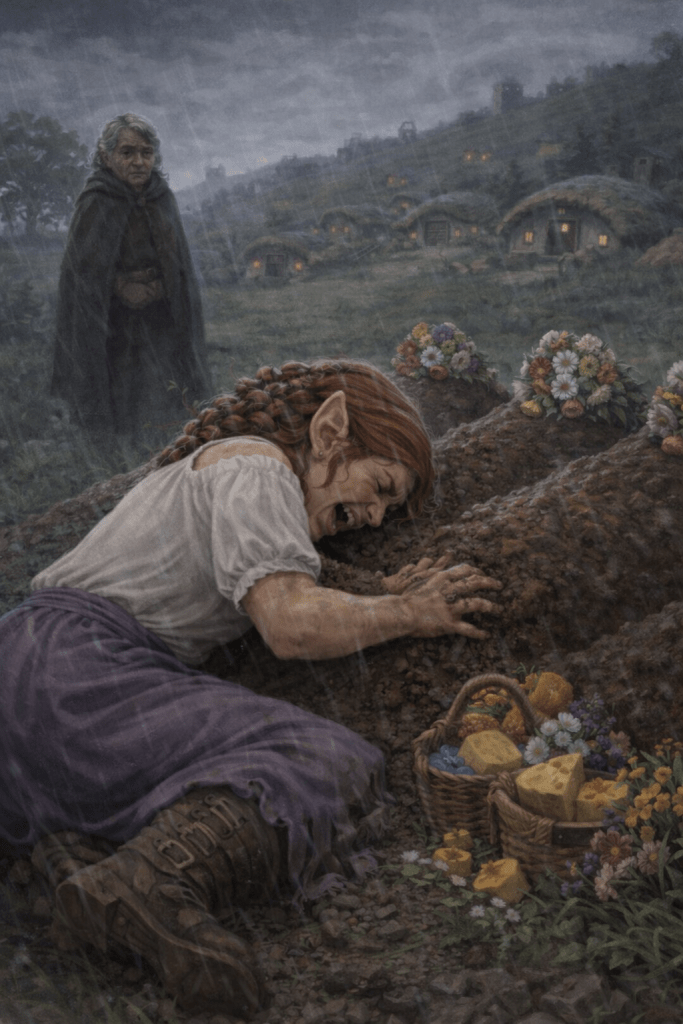
Melia made the trek down from the foothills back to the burrows, ignoring the package and note in her grief-stricken state. Field wardens tried to warn her about the dark business that had occurred, but she walked past them without acknowledgment until her mother-in-law Helena Havelock appeared, her face marked with soot and looking older than Melia remembered. When Melia could only speak the names of her lost family, Helena nodded and pointed behind the burrows to a partially cleared field where four new mounds marked the graves of Nicker, Petal, Boberry, and Belfast, decorated with flowers, baskets, breads, and cheeses left by other halflings who had paid their respects.
Melia lay down upon the graves and cried for the first time, feeling as though part of her was trying to give up onto the ground. Days passed as she remained there, sometimes in rain, with others coming by reverently but leaving her alone with her grief. She felt a pervasive hollowness and could not find comfort in the familiar surroundings or the presence of her mother-in-law and community. Everything that should have felt like home now seemed to be on the other side of a mirror, visible but unreachable, and she developed a growing sense that she could not remain in this place without her family. Eventually, primal needs like hunger and physical discomfort reminded her of her connection to the physical world, and she stood from the graves, finding it unbearable to look at the now-empty burrows.
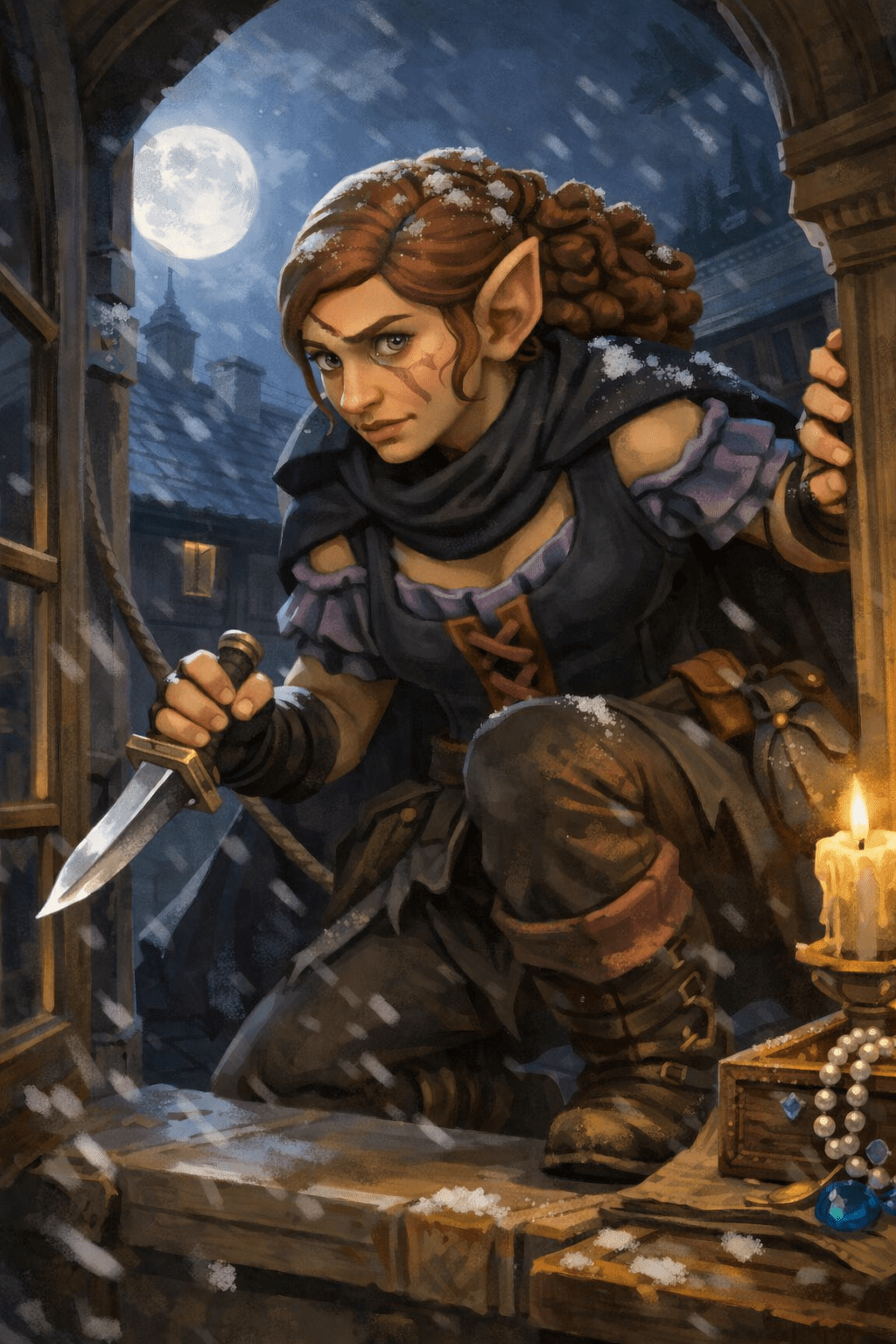
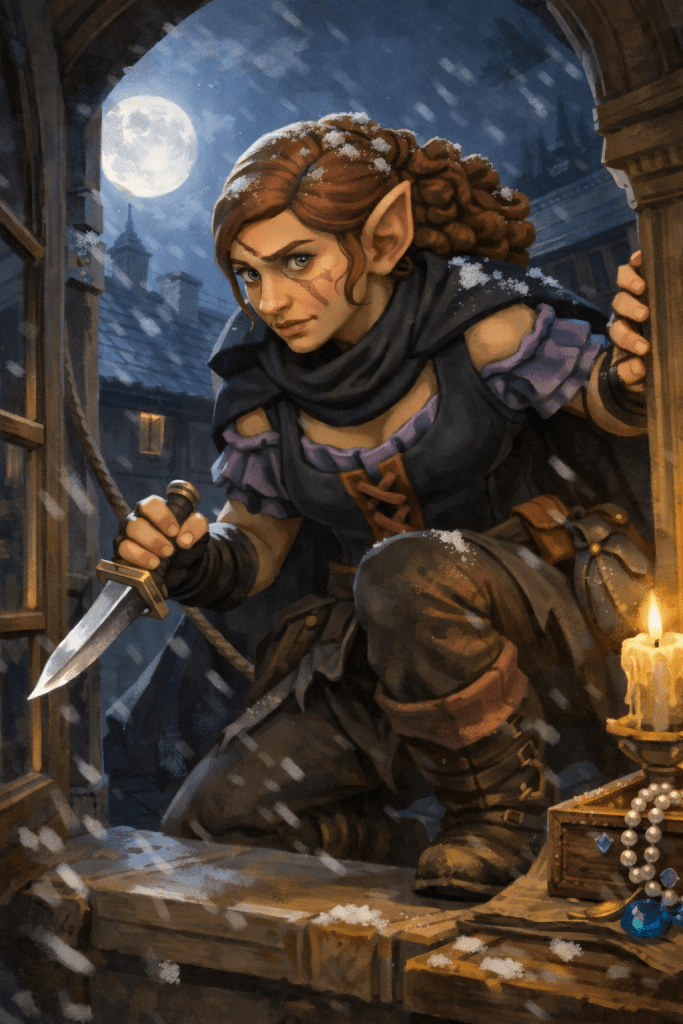
Driven by an overwhelming need to escape the memories and familiar sights, Melia began walking away without reason or purpose. Over the next two years, she wandered from town to town in a blur, struggling to take care of herself and sometimes begging for food to avoid starvation, though part of her wished to die. A small piece of her kept her going, leading her to steal food and pick pockets to survive, and she began to prey on the world around her, feeling that if others could take from people thoughtlessly and viciously, she could do the same. She became quite proficient at sleight of hand and thievery, sometimes acting with deliberate cruelty, and began to appreciate taking from others not for material gain but for the power it gave her and the opportunity to make others feel the misery she carried.
By the time Melia arrived in Talabec, she had earned a reputation as an accomplished thief who took pleasure in inflicting suffering on others. She remembered the note from Hara and the name Pushka Ironwright, someone she could meet in this town who might offer her a new beginning. The halfling who had once woven baskets by the hearth and cared for her family was gone, replaced by someone who had been hollowed out by loss and transformed into a person who wielded the only power she felt she had left—the power to take from others what had been so violently taken from her.
 Tales of Urchin Keep
Leave a comment